 admin
Digital slot games are among the most popular formats of online entertainment, offering simple gameplay paired with complex underlying mechanics. To evaluate slot games objectively, players must understand core mathematical principles such as Return to Player (RTP) percentages, game volatility, payline structures, and Random Number Generator (RNG) execution.
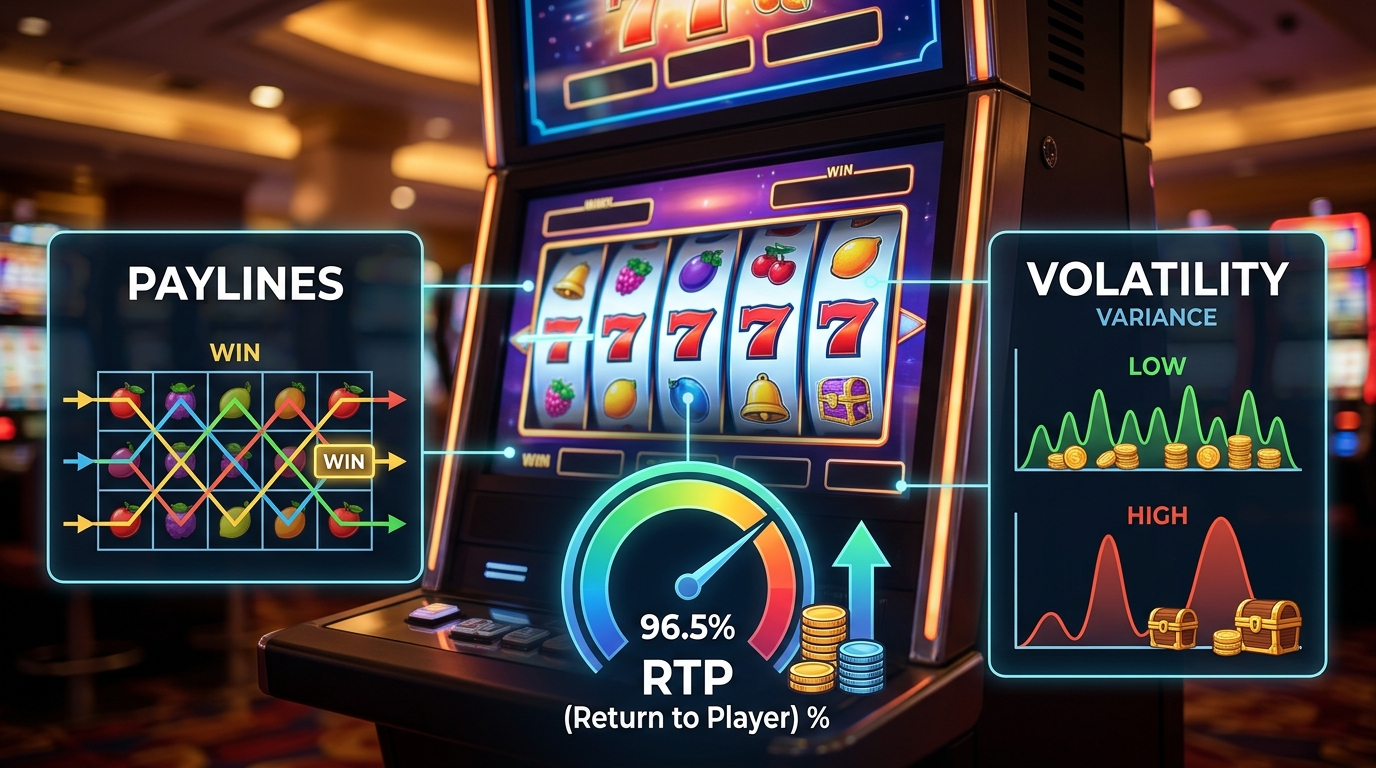
At the core of every digital slot machine is the Return to Player (RTP) metric. Expressed as a percentage, RTP represents the theoretical long-term statistical payout of a game over millions of automated spins. For example, a slot game with a calculated RTP of 96% indicates that, theoretically, the game retains 4% as the house edge while returning 96% of all accumulated wagers back to the overall player pool over an infinite sample size. It is critical to recognize that RTP is a statistical average and does not guarantee specific outcomes during short-term individual gaming sessions.
Volatility, often referred to as variance, describes the risk profile and payout distribution pattern of a specific slot game. Games classified as high volatility pay out less frequently on average, but individual winning combinations hold potential for higher relative payout multipliers. Conversely, low volatility slots offer more frequent winning combinations, but individual payout values are typically smaller. Medium volatility titles seek a balance between win frequency and payout size. Understanding volatility helps users select games that align with their personal preferences and budget management plans.
The underlying mechanics of slots have evolved significantly beyond traditional three-reel layouts. Modern video slots feature varied structural configurations, ranging from multi-payline grids to non-traditional reel systems. Fixed paylines require winning combinations to land on specific predetermined lines, whereas “Ways to Win” systems pay out as long as matching symbols appear on adjacent reels regardless of vertical position. Advanced mechanics like cluster mechanics and cascading reels remove winning symbols to allow new symbols to fall into place, creating potential secondary combinations within a single turn.
All legitimate slot mechanics operate strictly via certified Random Number Generators (RNGs). The RNG constantly calculates random mathematical values, determining the position of the reels the exact millisecond a spin command is submitted. Previous spins, total duration of play, and historical win/loss balance have zero statistical impact on future outcomes. Educating oneself on these underlying mechanics allows users to view digital slot gaming through an informed, realistic lens focused strictly on entertainment value rather than expected financial return.